

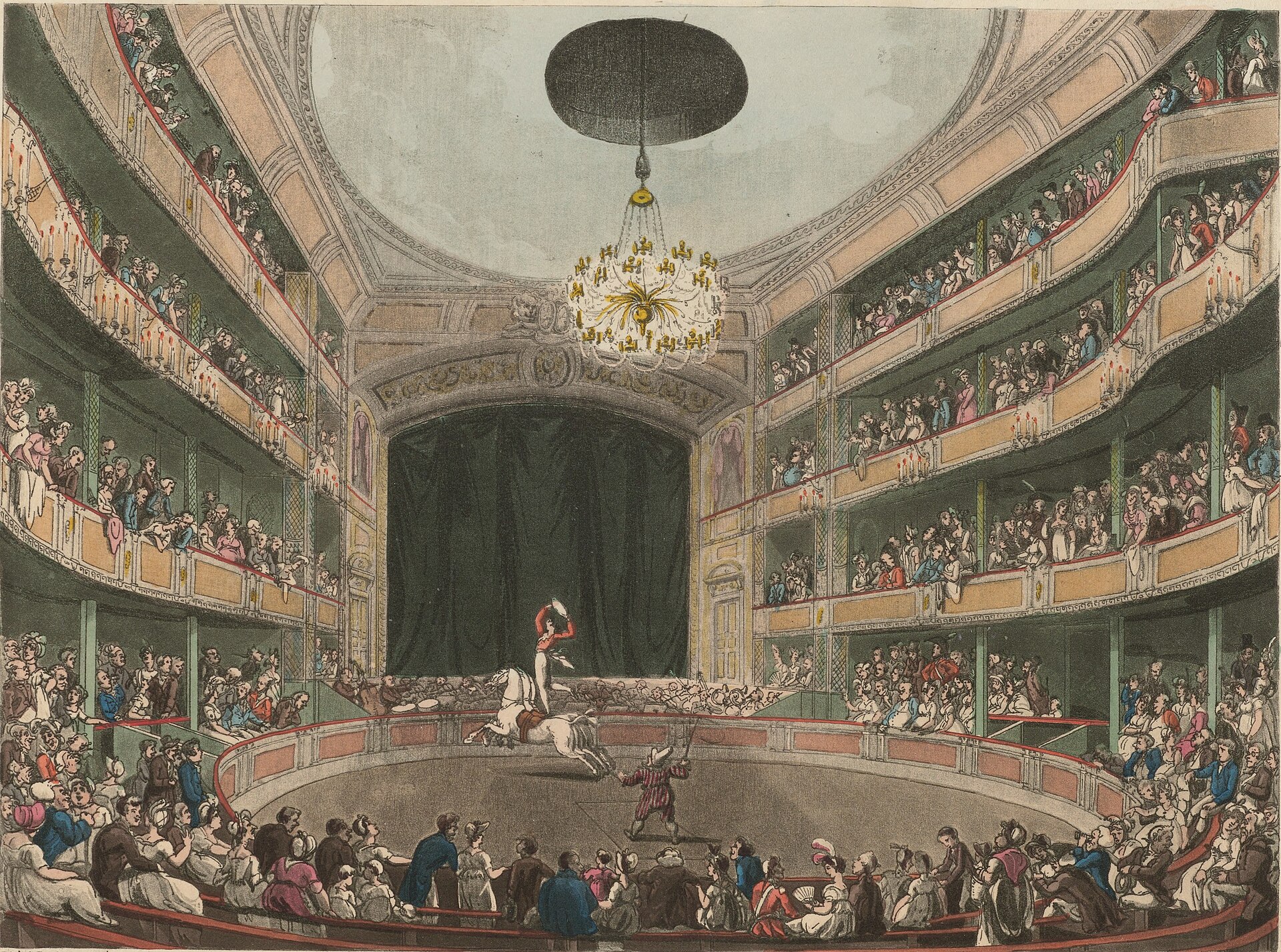
Every circus you have ever sat in, from a travelling big top on a playing field to a glittering show in Monte Carlo, owes something to a man who is traditionally said to have been born in Newcastle-under-Lyme almost three centuries ago.
Who Was Philip Astley?
Philip Astley is usually said to have been born on 8 January 1742. His father, Edward, was a cabinet maker, and young Philip was put to work as his apprentice at around the age of nine. Carpentry never really suited him, though. What he loved was horses.
At 17 he left the workbench behind and joined the 15th Light Dragoons, a newly raised light cavalry regiment. It was a good fit. Astley was well over six feet tall, had a voice that carried, and handled horses with a skill that soon marked him out. He was given extra training in riding, which included the kind of trick riding that would later make his name.
He saw action in the Seven Years' War, and his big moment came at the Battle of Emsdorf in 1760. Despite being unhorsed and wounded, he is credited with capturing enemy colours, which he later presented to King George III. By the time he left the army in 1766 he had risen to sergeant major.
How Did The Circus Begin?
Back in civilian life, Astley decided to make a living from what he did best. In 1768, together with his wife Patty, herself an accomplished rider, he began staging shows on an open patch of ground called Halfpenny Hatch in Lambeth, south of the Thames. He taught riding in the mornings and performed daring feats of horsemanship in the afternoons: standing on galloping horses, riding with one foot on the saddle and the other on the horse's head, and flourishing a cavalry sword. By 1769 he had moved to a site at the foot of Westminster Bridge.
The secret of his act was the circle. Galloping round a ring meant the audience could follow every move, and the force of turning in a tight circle helped riders stay balanced as they stood on their horses' backs. Astley did not invent the idea of riding in a ring, but the circus ring of about 42 feet (13 metres) across that became linked with his shows is still the standard size today.
His real stroke of genius was what he put between the riding acts. By 1770 he was hiring acrobats, tightrope walkers and jugglers, and bringing on a clown to keep the crowd laughing while the horses rested. Riding, acrobatics, comedy and music, all in one ring: the modern circus had arrived, although Astley himself never called it that. The word "circus" was taken up by a rival venue that opened nearby in 1782.
His venue grew into Astley's Amphitheatre, one of the best-known places of entertainment in Georgian and Victorian London. It burned down several times and was rebuilt each time, and it earned royal patronage. It was so famous that Jane Austen has characters in Emma going to "Astley's" for an evening out.
Astley also took his shows abroad. He performed for the French royal court and in the early 1780s set up the Amphithéâtre Anglais in Paris, one of about 19 permanent circuses he is credited with founding across Europe. He died at his home in Paris in October 1814 and was buried in the cemetery that is now Père Lachaise.
Why Is Newcastle-under-Lyme Linked To Him?
There is one twist for local historians. No baptism record has been found, and a survey of his Paris grave made shortly after his death recorded Manchester as his birthplace, with a slightly earlier date. Even so, Newcastle-under-Lyme has long been accepted as his home town, and the borough has taken him to heart.
The Circus250 celebrations in 2018 marked 250 years since those first shows in Lambeth, and Newcastle was part of them. Today the Philip Astley Centre at 25 Merrial Street, a heritage centre dedicated to his life and legacy, runs exhibitions, talks and workshops. Entry is free, but check the opening times before you go.
Did you know Newcastle-under-Lyme could claim to be the birthplace of the circus? Tell us in the comments, and let us know if you've visited the Philip Astley Centre.



Comments
0No comments yet. Be the first.